So, you are looking for a Newfoundland puppy. Few things are more appealing than a fluffy Newfoundland puppy, and today’s websites and social media platforms are filled with charming photos and videos of puppies at play. While it is easy to be captivated by puppy cuteness, it is important to pause and remember that this decision will impact your family for the next 10 to 15 years.
Not all responsible breeders maintain websites, but many do use websites and social media to share information about their dogs, accomplishments, and breeding philosophy. Beginning your search online can be a helpful first step in adding a Newfoundland to your family. Unfortunately, irresponsible breeders also use internet tools to market puppies for sale, sometimes with very polished presentations.
A breeder’s website or social media presence is a useful starting point—but it should never replace research, verification, and personal communication. Responsible breeders welcome questions, value transparency, and care deeply about where their puppies go. Choosing a breeder carefully helps ensure that your Newfoundland will be a healthy, well-bred companion for years to come.
If you find a breeder website of interest, it should be considered only the first step in the process. This should be followed by thoughtful email exchanges, phone or video conversations, references, and—when possible—an in-person visit.
🚩 Red Flag
Be very wary of breeders who are willing to complete the entire transaction online without meaningful personal contact.
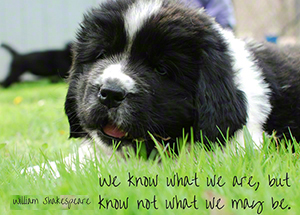
The internet has changed how prospective buyers find breeders compared to 10 or 20 years ago, but the core qualities of a responsible breeder have not changed. Ethical breeders are devoted to their dogs and committed to the long-term health and future of the Newfoundland breed. Not every responsible breeder is a technology expert. Their focus is their dogs—not web design, social media trends, or constant puppy promotion. A professional-looking website does not guarantee ethical breeding practices. When evaluating a breeder online, always look for substance over flash.
✔ Full Registered (AKC) Names of Their Dogs
Every Newfoundland bred in the United States should be registered with the American Kennel Club (AKC). International breeders should register dogs with the recognized kennel club of their home country.
Using full registered names allows prospective buyers to independently verify:
• Health testing results
• Titles and awards
• Pedigree information
Examples of registered names:
Highpoints Three Times a Charm
Stonehaus Summer Breeze
🚩 Red Flag
Websites or social media pages that list only call names for breeding dogs may seem more informal or friendly, but this limits a buyer’s ability to verify health testing and title claims.
🚩 Red Flag
Breeders who do not register dogs with the AKC (or a recognized national kennel club) and instead use alternative or “knock-off” registries such as APRI, DRA, or NAPR.
✔ Pedigree Information or Access to It
Each breeding dog should have information about their parents. A pedigree is a dog’s family tree, typically spanning three to five generations. If a pedigree is not publicly posted, a responsible breeder should be willing to provide it upon request.
Pedigrees often include:
• Titles (e.g., CH for Champion, WRD for Water Rescue Dog)
• Health clearances
Buyers should always verify claims through reliable databases. Phrases such as “championship lines” or “champion pedigree” are meaningful only when champions appear in the first few generations. Dogs closest to the left side of the pedigree (parents, grandparents, and great-grandparents) have the greatest genetic influence. A pedigree where 50% or more of the first three generations are champions is far more significant than one with a single champion several generations back.
✔ Health Clearances
Responsible breeders screen their breeding stock for known genetic conditions. The Newfoundland Club of America considers the following health tests essential for all Newfoundlands:
• Hips (x-ray)
• Elbows (x-ray)
• Cystinuria (DNA testing or parentage)
• Heart (evaluation by a board-certified cardiologist)
Additional recommended testing includes:
• Eyes (CERF/CAER)
• Thyroid (blood test)
• Patellas (palpation)
DNA banking is also strongly encouraged.
A responsible breeder will clearly state which health screenings are performed and will either:
• Publish results through public databases such as OFA or the NCA Health Database, or
• Provide copies of health clearances upon request
One hallmark of a responsible breeder is the effort made to gather as much health information as possible before planning a breeding.
🚩 Red Flag
Breeders who do not perform health testing and justify it with statements such as:
• “I’ve never had a problem before,” or
• “They all run around the yard just fine.”
🚩 Red Flag
Breeders who make excuses for non-passing results like
• "injury as a puppy"
• "got a second opinion and the vet said they were fine"
✔ Titles and Activities
Many responsible breeders actively participate in the sport of purebred dogs. Newfoundland breeders who are passionate about the breed evaluate their dogs in the conformation ring, preserve working instincts, and showcase their dogs’ abilities in a wide range of activities.
Newfoundlands earn titles and certifications in:
• Conformation
• Obedience and Rally
• Agility and Tracking
• Water Rescue and Draft Work
Breeder participation in these activities demonstrates time invested in training, evaluation, and continued education. Active involvement also keeps breeders connected to the broader dog community and current developments in health, breeding, training, and husbandry.
🚩 Red Flag
Breeders who do not participate in any activities with their dogs and whose dogs never leave the property.
✔ Membership in Dog Clubs
As a general rule, responsible Newfoundland breeders belong to a regional Newfoundland club and/or the Newfoundland Club of America (NCA). Many also belong to all-breed clubs.
Club involvement provides education, mentorship, and opportunities for public outreach. Responsible breeders are willing to share knowledge and learn from others, and club membership supports both goals.
Note: The American Kennel Club does not have individual members—it is a “club of clubs.” Be cautious of breeders who claim to be “AKC members.”
🚩 Red Flag
Breeders who do not participate in any dog-related clubs, organizations, or educational groups.
✔ Number of Breeds and Dogs
Breeding a giant, long-haired breed such as the Newfoundland is expensive, time-consuming, and labor-intensive. Adult dogs require regular grooming, training, and exercise, and puppies require around-the-clock care for weeks.
While it is possible to responsibly breed more than one breed, it is uncommon for a conscientious breeder to devote adequate time and resources to more than one or two breeds.
🚩 Red Flag
• Breeders producing puppies from more than three breeds
• Multiple females bred repeatedly to the same “house” stud dogs
• Females bred in consecutive seasons
• Advertisements stating puppies are “always available”